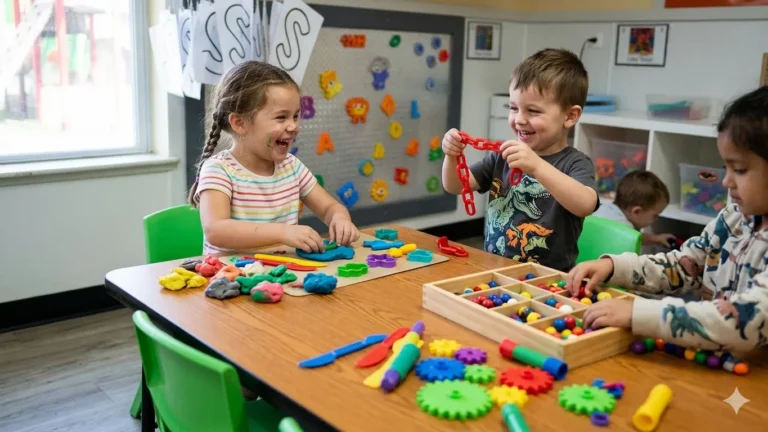
Supporting healthy child development doesn’t require expensive toys, complicated lesson plans, or hours of structured activities. In fact, some of the most meaningful moments for child development happen during everyday routines—reading together, asking questions, playing, and exploring the world around them. At STEM Child Care, we believe curiosity is the foundation of lifelong learning, and parents play an incredible role in helping children develop confidence, creativity, and a passion for discovering new things.
The good news is that encouraging healthy child development can be simple, fun, and woven naturally into your family’s daily life.
Why Curiosity Is Essential for Child Development
Curiosity is one of the greatest drivers of child development. When children are encouraged to ask questions, solve problems, and explore their interests, they build important cognitive, social, and emotional skills that support success in school and beyond.
Rather than focusing only on memorizing facts, children learn how to think critically, make connections, and develop resilience when they are free to explore.
Here are seven simple ways you can nurture child development and inspire a lifelong love of learning at home.
1. Encourage Questions Every Day
Children are naturally curious.
You may hear questions like:
- Why is the sky blue?
- How do birds fly?
- Why do leaves change color?
- How do fish breathe underwater?
Instead of immediately providing the answer, invite your child to discover it with you.
You might say:
- “That’s a great question! Let’s find out together.”
- “What do you think happens?”
- “How could we test that idea?”
Exploring answers together teaches children that learning is exciting and that asking questions is an important part of healthy child development.
2. Read Together Every Day
Reading remains one of the most powerful ways to support child development.
Just 15–20 minutes of reading each day helps children strengthen:
- Vocabulary
- Listening skills
- Imagination
- Memory
- Early literacy
- Language development
Choose books that match your child’s interests, whether that’s dinosaurs, trucks, animals, princesses, or outer space. Don’t worry about reading the same book repeatedly—repetition builds confidence and reinforces learning.
Make reading interactive by asking questions about the story, predicting what might happen next, or talking about your favorite characters.
3. Turn Everyday Play Into Learning
Play is one of the most effective tools for child development because children learn best when they’re actively engaged.
Simple activities can teach important concepts without feeling like lessons.
Try activities like:
- Building towers with blocks to explore engineering
- Mixing colors with paint to discover science
- Counting toys during cleanup to practice math
- Cooking together to introduce measuring
- Nature walks to observe plants, insects, and weather
- Sorting objects by size, shape, or color
At STEM Child Care, we incorporate hands-on STEM learning every day because exploration helps children develop curiosity, creativity, and problem-solving skills.
4. Celebrate Effort Instead of Perfection
Healthy child development isn’t about getting every answer right.
Instead of saying:
“You’re so smart!”
Try saying:
- “You worked really hard on that.”
- “I noticed you didn’t give up.”
- “I’m proud of how you kept trying.”
Praising effort teaches children that mistakes are opportunities to learn. This growth mindset encourages resilience, confidence, and persistence—qualities that benefit children throughout life.
Everyday Habits That Support Child Development
Small daily habits often have the biggest impact on long-term child development.
5. Be a Role Model for Learning
Children learn by watching the adults around them.
Let your child see you:
- Reading books
- Trying a new recipe
- Learning a hobby
- Fixing something around the house
- Asking questions
- Looking up interesting facts
When children see adults enjoying learning, they begin to view learning as something exciting rather than something they have to do.
6. Follow Your Child’s Interests
Every child develops unique passions.
Some children love:
- Dinosaurs
- Space
- Construction vehicles
- Animals
- Music
- Art
- Nature
- Bugs
Instead of steering them toward what you think they should learn, lean into what already excites them.
Visit the library, explore museums, create themed crafts, or watch age-appropriate educational videos together. Following your child’s interests keeps learning meaningful and supports natural child development.
7. Keep Learning Positive and Fun
One of the best gifts you can give your child is the confidence to enjoy learning.
Avoid turning every activity into a test or quiz.
Instead:
- Celebrate curiosity
- Laugh together
- Explore without pressure
- Encourage creativity
- Let children make mistakes
- Focus on the experience rather than the outcome
A positive environment helps children associate learning with joy rather than stress, supporting healthy child development for years to come.
How STEM Child Care Supports Child Development
At STEM Child Care, child development is at the heart of everything we do.
Our classrooms are intentionally designed to help children grow academically, socially, emotionally, and physically through engaging, hands-on experiences.
Our programs include:
- STEM-focused exploration
- Play-based learning
- Early literacy and math activities
- Science experiments
- Social-emotional learning
- Creative art and music
- Outdoor discovery
- Problem-solving challenges
We believe every child is naturally curious, and our teachers create an environment where that curiosity can flourish every day.
Final Thoughts
Supporting your child’s child development doesn’t require perfection—it simply requires presence. Reading together, encouraging questions, celebrating effort, and making time for play all help children develop confidence, resilience, and a lifelong love of learning.
At STEM Child Care, we’re proud to partner with families to nurture every aspect of child development. If you’re looking for an engaging early learning environment where curiosity is encouraged and every child is supported, we’d love to meet your family. Schedule a tour today and discover how we help children learn, grow, and thrive.
Frequently Asked Questions
Why is curiosity important for child development?
Curiosity encourages children to ask questions, solve problems, build confidence, and develop critical thinking skills that support lifelong learning.
What activities best support child development at home?
Reading, imaginative play, STEM activities, outdoor exploration, arts and crafts, puzzles, and conversations all help support healthy child development.
How much should I read with my child each day?
Experts recommend reading together for at least 15–20 minutes each day to support language development, literacy, and brain development.
Can play really improve child development?
Yes. Play is one of the most effective ways children develop cognitive, social, emotional, and physical skills while building creativity and problem-solving abilities.
How can I encourage my child to enjoy learning?
Create a positive environment by celebrating effort, encouraging curiosity, following your child’s interests, and making learning fun through everyday experiences.