When parents begin searching for the perfect preschool, one question often comes up: STEM preschool vs traditional preschool—what’s the difference, and which option is best for my child? In today’s world of smart technology, innovation, and constant discovery, many families are wondering whether a STEM-focused preschool provides advantages that extend beyond the classroom.
The good news is that both types of preschool help children learn and grow. However, understanding the differences between a STEM preschool vs traditional preschool can help you choose the environment that best matches your child’s personality, interests, and future learning goals.
At STEM Child Care, we believe every child is naturally curious. From asking why worms wiggle to wondering why the moon follows the car home, preschoolers are constantly exploring the world around them. A STEM-focused preschool embraces that curiosity and turns everyday moments into exciting learning opportunities.
What Is the Difference Between a STEM Preschool vs Traditional Preschool?
The biggest difference between a STEM preschool vs traditional preschool is how children experience learning.
Traditional preschools often introduce early literacy, numbers, art, music, and social-emotional development through structured lessons, crafts, and teacher-guided activities. These programs provide an excellent foundation for many children.
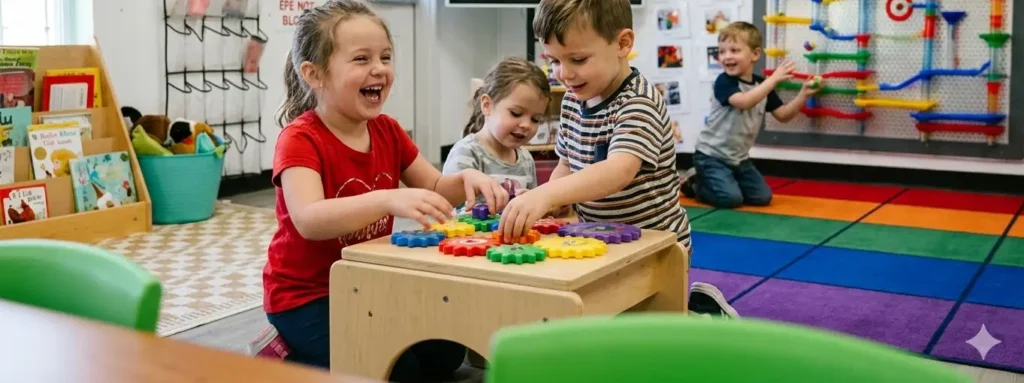
A STEM preschool includes all of those important developmental areas but places a greater emphasis on exploration, problem-solving, experimentation, and hands-on learning. Rather than simply teaching children facts, STEM education teaches them how to think.
Children are encouraged to ask questions, make predictions, test ideas, and learn from both successes and mistakes.
For young learners, that often looks like play—but every activity has a purpose.
Why More Parents Are Choosing STEM Preschool
As technology continues to shape nearly every career field, parents are increasingly interested in educational programs that prepare children with lifelong skills rather than simply academic knowledge.
When comparing STEM preschool vs traditional preschool, many families appreciate that STEM learning encourages curiosity, resilience, creativity, and confidence from an early age.
Instead of memorizing information, children become active participants in their own learning.
STEM Preschool Encourages Curiosity and Exploration
Young children are naturally curious.
They ask questions all day long:
- Why is the sky blue?
- Why do magnets stick?
- Why can’t I have cookies for breakfast?
A STEM preschool doesn’t rush past those questions—it celebrates them.
Whether children are building tall towers, experimenting with magnets, planting bean sprouts, or racing toy cars down homemade ramps, they’re learning through discovery.
These hands-on experiences help children understand that asking questions is just as important as finding answers.
One day they’re dropping marbles through cardboard tubes.
The next day they’re discovering gravity without even realizing it.
That’s the magic of STEM learning.
STEM Learning Builds Strong Foundational Skills
One of the biggest advantages when comparing STEM preschool vs traditional preschool is how academic concepts are introduced.
Forget endless flashcards.
Children naturally develop early math and science skills through play.
They learn by:
- Counting blocks
- Sorting shapes
- Measuring ingredients
- Comparing sizes
- Identifying patterns
- Making predictions
- Testing ideas
These playful experiences strengthen:
- Early math skills
- Number sense
- Spatial awareness
- Logical thinking
- Scientific observation
Best of all, children remain excited because learning feels like play rather than work.
STEM Preschool Develops Collaboration and Communication
Another major difference in the STEM preschool vs traditional preschool discussion is how children solve problems together.
Many STEM activities naturally encourage teamwork.
Imagine four preschoolers trying to build a bridge using marshmallows and spaghetti.
They quickly learn to:
- Share materials
- Listen to ideas
- Communicate clearly
- Take turns
- Solve disagreements
- Celebrate each other’s successes
These social-emotional skills are just as valuable as learning letters and numbers.
In fact, employers consistently rank communication, collaboration, and problem-solving among the most important lifelong skills.
STEM introduces those abilities much earlier than many parents realize.
STEM Preschool vs Traditional Preschool and Kindergarten Readiness
One question parents frequently ask is whether a STEM preschool vs traditional preschool better prepares children for kindergarten.
Research and classroom experience suggest that children benefit greatly from learning environments that balance academic readiness with exploration.
STEM-rich classrooms help children strengthen:
- Fine motor skills
- Vocabulary
- Listening skills
- Attention span
- Memory
- Critical thinking
- Problem-solving
- Independence
Just as importantly, children develop confidence.
Instead of worrying about making mistakes, they begin to understand that mistakes are part of learning.
That mindset becomes incredibly valuable once they enter elementary school.
Children who are encouraged to explore often become children who enjoy learning.
STEM Builds Persistence
One benefit that often surprises parents is persistence.
When children become genuinely interested in solving a problem, they naturally stay engaged longer.
Whether they’re figuring out why their tower keeps falling over or experimenting with what makes a paper airplane fly farther, they learn to keep trying.
These experiences teach resilience in a way worksheets simply can’t.
Curiosity fuels perseverance.
And perseverance builds confident learners.
STEM Makes Learning Fun
Perhaps the biggest difference when discussing STEM preschool vs traditional preschool is how children feel about learning.
STEM learning is active.
It’s colorful.
It’s sometimes messy.
It often includes:
- Mixing colors
- Launching paper rockets
- Building obstacle courses
- Watching ice melt with salt
- Growing plants
- Exploring insects outdoors
- Creating simple machines
- Making predictions before experiments
Children don’t always realize they’re learning because they’re too busy having fun.
Those joyful experiences create positive associations with school that can last for years.
Should You Choose a STEM Preschool or Traditional Preschool?
There isn’t one perfect answer for every family.
Both traditional and STEM-focused preschools can provide wonderful early childhood experiences.
However, if you’re looking for a program that emphasizes:
- Hands-on exploration
- Critical thinking
- Creativity
- Problem-solving
- Collaboration
- Curiosity
- Kindergarten readiness
- Confidence through discovery
Then a STEM-focused preschool may be the ideal fit.
Rather than simply preparing children to answer questions correctly, STEM education prepares them to ask thoughtful questions, investigate solutions, and develop a lifelong love of learning.
Why Families Choose STEM Child Care
At STEM Child Care, we believe every day is an opportunity for discovery.
Our classrooms transform ordinary moments into extraordinary learning experiences through science experiments, engineering challenges, sensory exploration, creative problem-solving, and purposeful play.
Children build more than academic knowledge.
They build confidence.
They build resilience.
They build curiosity.
Most importantly, they develop a genuine excitement for learning that extends far beyond preschool.
So the next time your child proudly explains why their bathtub boat sank or excitedly tells you how a caterpillar becomes a butterfly, you’ll know something wonderful is happening.
That’s STEM in action.
Frequently Asked Questions
Is a STEM preschool better than a traditional preschool?
Neither is universally better. When comparing STEM preschool vs traditional preschool, the best choice depends on your child’s learning style and your family’s goals. STEM programs place greater emphasis on hands-on exploration, critical thinking, and problem-solving while still supporting literacy, social skills, and emotional development.
What is taught in a STEM preschool?
A STEM preschool teaches science, technology, engineering, and math concepts through play-based activities like building, experimenting, observing nature, measuring, counting, and solving simple challenges. Children also develop language, creativity, and social-emotional skills.
Will my child still learn reading and writing in a STEM preschool?
Yes. STEM preschools include early literacy alongside STEM activities. Storytime, letter recognition, vocabulary development, and early writing are integrated throughout the curriculum.
Is STEM preschool good for kindergarten readiness?
Absolutely. STEM learning supports kindergarten readiness by strengthening critical thinking, communication, fine motor skills, early math, vocabulary, independence, and persistence.
What age should children start STEM learning?
Children can begin STEM learning as early as infancy through age-appropriate exploration. Preschool is an ideal time because young children are naturally curious and eager to experiment with the world around them.